Showing posts with label China history. Show all posts
Thursday, May 15, 2014
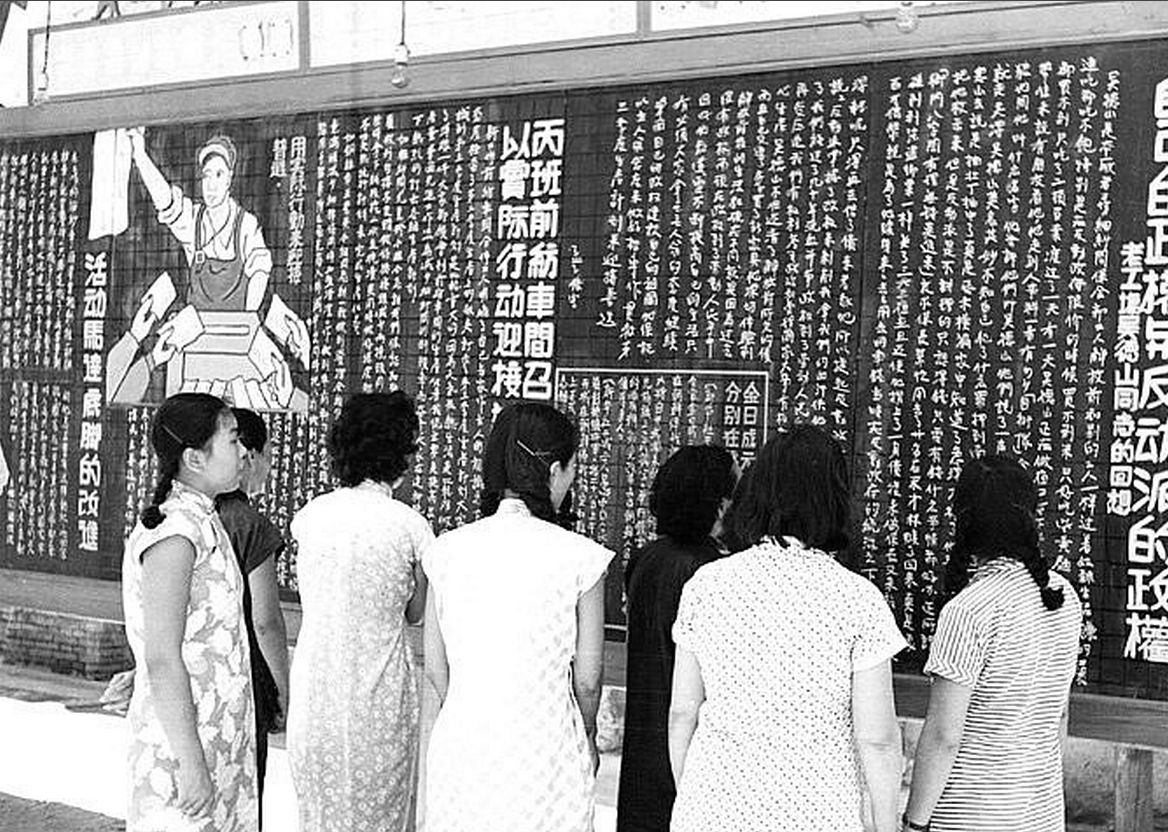
Da Zi Baos, the cause of division between a nation
Da Zi Baos, were very common in China during the cultural revolution. They were a form of propaganda that Mao's followers used to humiliate "anti-revolutionaries" or to promote Mao. Da Zi Baos were often used in school environments. Ji-Li Jiang, the author of The Red Scarf Girl had to write them when she was in school in China. For a while, all classes were canceled and the students had to write Da Zi Baos all day. Many of them were about their teachers and how they had been wronged by them. Da Zi Baos were just another way to create a division between the revolutionaries, and the citizens with a bad class status.
Labels:
China history,
Chinese people,
Cultural revolution,
Da Zi Bao,
Mao,
Red Scarf Girl
Monday, May 12, 2014
Tiananmen Square, A continuous fight back
The Tienanmen Square protests of 1989 are some of the most well known protests worldwide. It is the most sensitive day in Chinese history. The government has gone as far as arresting people who invoke its memory. Many of the families who were affected by the 1989 massacre have been placed under house arrest or are kept under surveillance. As the 25th anniversary approaches, the government has ramped up these efforts.
The Chinese government is trying to erase the event from history. The Chinese government is taking great steps towards keeping the event under wraps. The government has detained many journalists and confiscated their equipment. The authorities use vague reasons for arresting these journalists, saying that they are “endangering national security”, and that they are “enemies of the state”. It is a crime for the rest of the world to stand by and watch these basic human rights violated so obviously by the Chinese government. It is time to do something.
China destroys statues as 'anti-Christian' campaign widens
The Chinese government has destroyed, removed, or hidden scenes including Jesus’ crucifixion. this has started fears of new offensive acts by the government that are being offensive against Christians. Many workers sealed off Wenzhou’s Longgang Hill, a site of Catholic pilgrimage, and used bricks to hide statues portraying moments from the Passion of Christ. Statues of Jesus, the Virgin Mary and Saint Joseph, each weighing up to five tons, were attempted to be hidden from view by having brick walls built around them, while cranes were used to remove other holy statues and tablets from the park. All of this goes back to censorship and total power for the Chinese government. Many Christians came to watch these hidings and destroying of their sacred statues and started crying, some even tried to sneak into the temples to pray and hope that their sacred monuments would be left and not destroyed. Wenzhou’s Sanjiang church became a symbol of resistance to the Communist Party’s draconian religious policies. Thousands of Christians formed a human shield around the place of worship after plans to demolish it were announced. The government did everything they could and got through the shield. They demolished the building and left tons of Christians in heartache. All of these actions are putting a bad reputation onto china. As an American I do not feel like China is a good place and I would not ever want to visit it. If I were to be Christian I would be hurt by this, I would want to do everything I could to try and stop these terrible actions. These acts could change a lot in China, Many other countries and places could look at this as taking away human rights and with that may end alliances or truces. This could lead to world wars and other fights. Many countries feel very strongly about their religion and if China decides to go against all of that then China will be hated by the rest of the world.
Friday, May 2, 2014
Chinese history, From bad to worse
1925 - The death of Sun Yat-sen brings Chiang Kai-shek as leader. He breaks with the Communists and confirms the governing Kuomintang as a nationalist party.
1931-45 - Japan invades, and gradually occupies more and more of China.
1934-35 - Mao Zedong emerges as communist leader during the "Long March"
1958 - Mao launches the "Great Leap Forward" (a five year economic plan)
1966-76 - "Cultural Revolution" Mao's 10-year political and ideological campaign.
1976 - Mao Dies
1986-90 - China's "Open Door" policy encourages encourages development of a market economy and private sector.
1989 - Hard line party leaders sent in troops to crush pro-democracy protests in Tiananmen Square.
1993 - Jiang Zemin officially replaces Yang Shangkun as president.
1995 - China tests missiles and holds military exercises in Taiwan (to intimidate Taiwan during its presidential elections).
1999 - Nato bombs the Chinese embassy in Belgrade and Yugoslavia. Falun Gong, a quasi-religious sect, outlawed as a threat to stability.
2000 - Crackdown on official corruption intensifies, with the execution for bribe taking of a former deputy chairman of the National People's Congress.
2001 - April, Diplomatic standoff over the detention of an American spy plane and crew after a mid-air collision with a Chinese fighter jet.
June, Leaders of China, Russia and four Central Asian states launch the Shanghai Cooperation Organisation (SCO) and sign an agreement to fight ethnic and religious militancy while promoting trade and investment
. June, China carries out military exercises simulating an invasion of Taiwan, at the same
November, China joins the world trade organization.
2002 - February - US President George W Bush visits, on the 30th anniversary of President Nixon's visit to China - the first by a US president.
July, The US says China is modernising its military to make possible a forcible reunification with Taiwan. Beijing says its policy remains defensive.
November, Vice-President Hu Jintao is named head of the ruling Communist Party, replacing Jiang Zemin, the outgoing president. Jiang is re-elected head of the influential Central Military Commission, which oversees the armed forces.
2003 - June - Sluice gates on Three Gorges Dam, the world's largest hydropower scheme, are closed to allow the reservoir to fill up.
June - Hong Kong is declared free of Sars. Days later the World Health Organization lifts its Sars-related travel warning for Beijing.
June - China, India reach de facto agreement over status of Tibet and Sikkim in landmark cross-border trade agreement.
July-August - Some 500,000 people march in Hong Kong against Article 23, a controversial anti-subversion bill. Two key Hong Kong government officials resign. The government shelves the bill.
October - Launch of China's first manned spacecraft: Astronaut Yang Liwei is sent into space by a Long March 2F rocket.
2004 - November, China signs a landmark trade agreement with 10 south-east Asian countries; the accord could eventually unite 25% of the world's population in a free-trade zone.
2006 - August, Official news agency says 18 million people are affected by what it describes as the country's worst drought in 50 years.
2014 - January, China allows foreign companies majority ownership of some telecom and internet services in the Shanghai free trade zone. They will be able to supply services nationwide except for home internet access, which will be restricted to the zone.
Monday, April 7, 2014
Ai Weiwei Never Sorry Review
The documentary, Ai Weiwei Never Sorry, directed by Alison Klayman, is about Ai Weiwei’s art and his influence on china. Ai Weiwei’s art reflects on the government and how they treat the regular citizen. The main purpose of the film is to show the true nature of the Chinese government. In 2011, Ai Weiwei was arrested for being so outspoken against the government. This documentary does an excellent job of showing the public response to Ai Weiwei’s arrest. “What can they do to me? none other than deportation, kidnapping and imprisonment, or make me completely vanish. @aww.”
Some themes that were in this documentary include hope, fear, censorship, and standing up for what you believe in. Hope is the driving force for Ai Weiwei. The only reason why he does what he does is because he believes that there is a chance for a better China. Another theme in the film is fear. Ai Weiwei is always living in fear. Ai Weiwei has to act brave even when he is afraid. He says “If you don’t act, the danger becomes stronger.” We also see fear in The Red Scarf Girl by Ji-Li Jiang. The Jiang family is living in constant fear of the red guards and being arrested. They deal with this fear in a very different way than Ai Weiwei. Ai Weiwei acts brave while the Jiang family has trouble sleeping. Another theme that we see in the documentary Ai Weiwei Never Sorry is censorship. The film shows how much the Chinese government censors the internet. The Chinese government blocks twitter and they withheld the names of all of the kids that died in the Sichuan earthquake. Ai Weiwei's name is one of the many things that China censors on the internet. "They all ask: Why? Why is it that this man’s name [Ai Weiwei] can never be typed on a Chinese computer or the whole sentence will disappear?" The final, and most important theme in this film is stand up for what you believe in. Ai Weiwei stands up for what he believes in even though it endangers him. Ai Weiwei is also a very inspirational person. At the demolition of Ai Weiwei’s art studio, hundreds of people came, even though they put themselves in danger. "Citizens should bear the responsibility to act."
The quality of this film was phenomenal. As a viewer, I was able to relate it to real life. We hear lots of news from China these days, and the documentary on Ai Weiwei showed a first hand experience on what was going on in China. In many of Ai Weiwei’s art pieces, he is giving the middle finger. Ai Weiwei used this symbol to show his displeasure about the current Chinese government. The documentary uses the symbol and the meaning of the middle finger to great affect.
This film was very interesting, It gave the viewers a real sense of what is going on in China today with all of the internet censorship.
Labels:
Ai Weiwei,
Ai Weiwei Never Sorry,
China,
China history,
Red Scarf Girl
Subscribe to:
Posts (Atom)